ACLA/CALL 2023 (Toronto)
Symposium: Intersectional inequalities among ELL students in Canadian schools: (Re)examining the convergence of language, race, religion, and gender.
Organizers: Rahat Zaidi and Pramod K. Sah

Paper: Zaidi, R., & Sah, P. K. (2023). Critically engaged literacy workshop: Examining newcomer students’ intersectionality in Canadian schools. ACLA-CALL Conference, Toronto, May 27-29.
AERA 2023 (Chicago, April 13-16)
Symposium: “Connecting the dots: Language ideologies, education (in)equities and multilingual realities in North America
Organizers: Huseyin Usyal and Pramod K. Sah

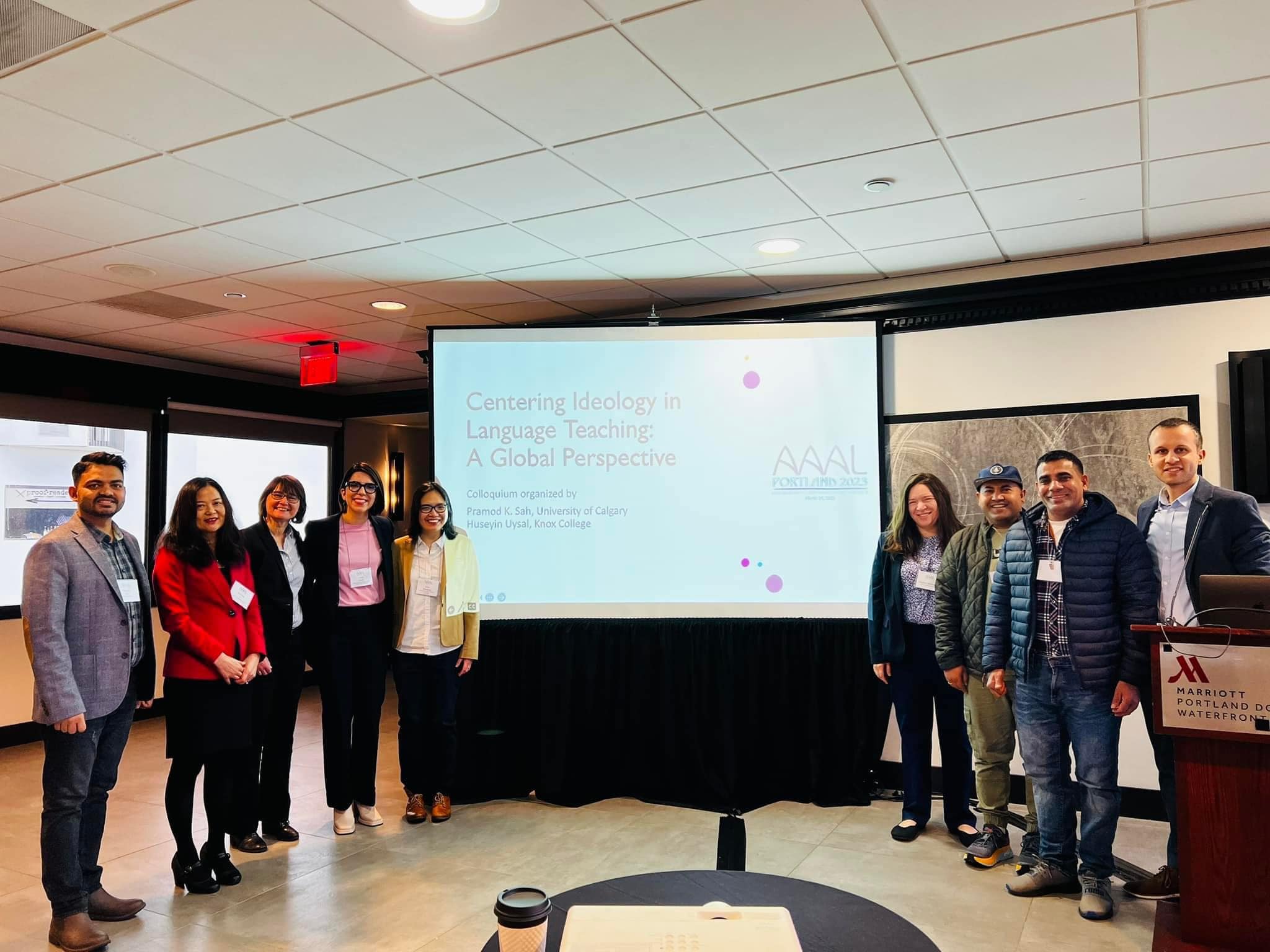
AAAL 2023 (Portland, 18-21 March)
Symposium: Centring ideology in language teaching: A global perspective
Organizers: Pramod K. Sah and Huseyin Usyal
Abstract:
With increasing number of multilingual students in schools and universities, exploring language ideology, “ideas with which participants frame their understandings of linguistic varieties and the differences among them” (Irvin, 1995, p. 970), is critical because it aims to unveil the underlying forces that influence the decisions, (inter)actions and aspirations of emergent multilinguals and their teachers (Tollefson & Yamagami, 2012). It is often observed that teachers’ pedagogical decisions and political actions are shaped by their worldviews and (Borg, 2010) and the language ideologies to which they subscribe (Haukås, 2016; Nuñez & Espinoza, 2019). Hence, language ideology often becomes a mechanism through which language learning processes, inside and beyond the classroom, are influenced. Given that language ideologies can cause feelings of cultural deficiency and create linguistic hierarchies amongst language learners, it is of utmost importance to question and understand ideologies in the micro-level of teaching and learning of English. Moreover, there is a need for more macro-level inquiry that examines the role of these ideologies in epistemically excluding certain learner groups from the larger community and seeks to curate inclusive spaces. Drawing on language ideology as a guiding framework, the studies presented in this colloquium contribute to the research base that defies the perpetuation of social inequalities through monoglossic language ideologies across varied educational and sociopolitical contexts (e.g., the U.S., South Korea and Hong Kong). Through an examination of various data sources, such as interviews, journals, observations, oral interactions, and autoethnographic accounts, the studies critically engage with the question of what roles language use behaviors of multilinguals, their teachers and parents and the underlying ideologies play in providing educational opportunities. Moreover, the studies interrogate implicit and explicit assumptions about educating multilingual students in different educational contexts in both English-speaking (the U.S.) and non-English-speaking (South Korea and Hong Kong) contexts.

Individual Paper 1: Entangled Teacher Emotions: Navigating Reciprocal Relations between Language Ideology, Identity, and Agency in English-Medium School Education.

Individual Paper 2: Emotions and Imagination in English-Medium Instruction Programs: Illuminating its Dark Side through Nepali Students


 Dr. Pramod K. Sah